
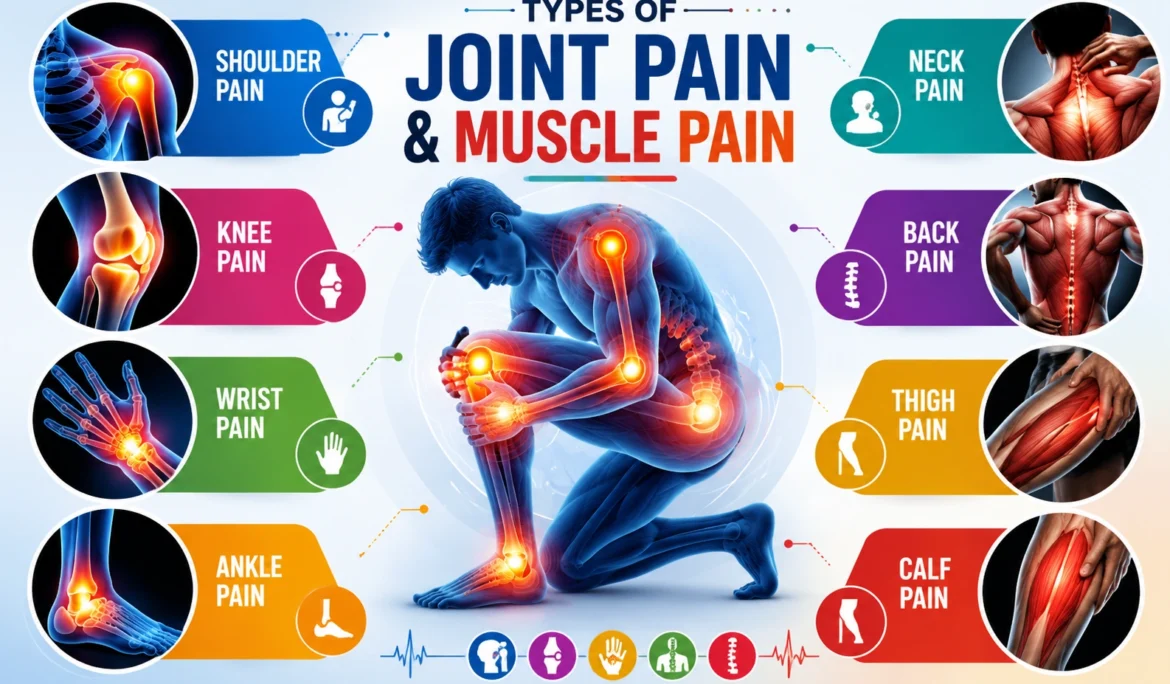
Up to 55% of sports and physical activity related injuries involve muscle strain, according to NCBI clinical research. This makes muscle strain one of the most common soft tissue injuries seen in orthopedic practice.
Muscle strain occurs when muscle fibers are stretched beyond their normal capacity. This overstretching causes microscopic tears in the muscle tissue. The body immediately responds with inflammation, which leads to pain, swelling, and stiffness. Inside the injured muscle, blood flow increases to repair damaged fibers. This healing response is necessary but also causes tightness and reduced movement in the affected area.
In Delhi, muscle strain is commonly seen due to gym workouts, long working hours in static posture, sudden lifting, and lack of warm-up before activity. These factors place repeated stress on muscle groups in the neck, back, calf, and legs.
Not all muscle pain is injury. Normal workout soreness (DOMS) appears within 24–72 hours and improves on its own. However, persistent localized pain, weakness, or swelling suggests a possible muscle strain that may require medical evaluation by a good Orthopedics specialist in Dwarka Delhi NCR.
Muscle Pain and Strain Cases
Muscle strain begins at the microscopic level when muscle fibers are overloaded beyond their elastic capacity. Clinical studies show that even small overstretching forces can disrupt sarcomeres, the basic contractile units inside muscle tissue.
Once these fibers are damaged, the body activates an inflammatory response. This response is essential for healing but also produces pain, swelling, and stiffness in the affected area. Fluid and immune cells accumulate around the injury site, increasing internal pressure within the muscle.
- Micro-tears in muscle fibers occur when load exceeds normal tolerance levels, leading to structural weakening
- Inflammation increases within hours, causing swelling and localized tenderness
- Pain receptors in surrounding tissue become highly sensitive, making movement uncomfortable
- Muscle contraction strength reduces due to disrupted fiber alignment
- Healing begins immediately but stiffness may persist for several days depending on severity
Muscle Strain Meaning
Muscle strain is defined as an injury caused by overstretching or excessive contraction of muscle fibers, leading to partial disruption of their structural integrity. Clinically, it is classified as a soft tissue injury affecting the muscle-tendon unit.
When strain occurs, the alignment of muscle fibers is disturbed. This reduces the muscle’s ability to generate normal force and coordinate movement efficiently. The severity depends on how many fibers are affected and how deeply the tissue structure is disrupted.
- Grade 1 strain involves minimal fiber damage (<5%), causing mild pain without major loss of strength
- Grade 2 strain involves partial tearing (up to ~30% fiber disruption), leading to noticeable weakness and swelling
- Grade 3 strain involves complete rupture of muscle fibers, resulting in severe pain and functional loss
- Inflammatory response begins immediately after injury, triggering swelling and tenderness
- Muscle performance decreases due to loss of structural continuity in fibers
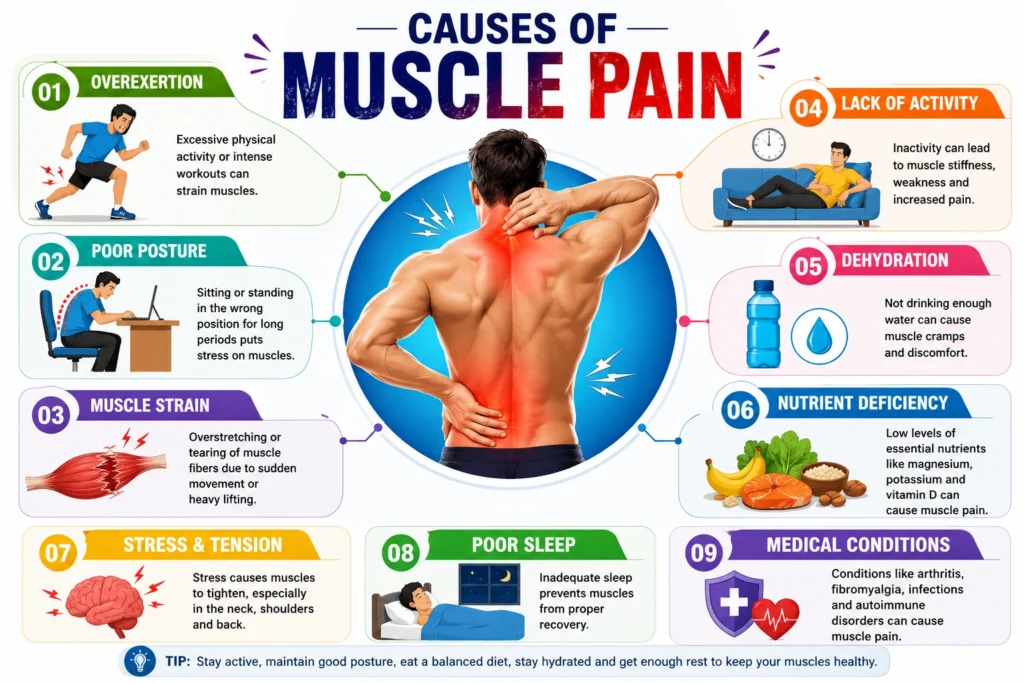
Why Muscle Pain Happens After Workout
Muscle pain after exercise is not always an injury. In many cases, it is caused by a condition called Delayed Onset Muscle Soreness (DOMS). Clinical exercise studies show that DOMS develops due to micro-level stress on muscle fibers during unaccustomed or intense activity.
This process is different from muscle strain because no major structural failure occurs. Instead, the muscle undergoes temporary biochemical and mechanical stress, leading to soreness and stiffness.
- DOMS typically appears 24–72 hours after exercise, not immediately after activity
- Pain is usually diffuse and spread across the muscle, not localized to one point
- Temporary micro-damage triggers mild inflammation, which resolves naturally
- Muscle stiffness reduces gradually without treatment within a few days
- Strength is mostly preserved, unlike in muscle strain where weakness is significant
Muscle Strain Symptoms and Warning Signs
Muscle strain symptoms appear when muscle fibers are partially damaged and inflammation begins in the affected tissue. Symptom intensity depends on the percentage of fiber involvement and location of injury. Early identification is important to prevent progression to more severe strain.
- Sharp or localized pain during movement, especially when the muscle is actively used
- Swelling within 6–24 hours, caused by inflammatory fluid accumulation around damaged fibers
- Muscle weakness during contraction, often reducing strength by 20–60% in moderate strain cases
- Tenderness at a specific point, indicating localized fiber disruption rather than general fatigue
- Stiffness lasting beyond 48–72 hours, which suggests injury rather than normal workout soreness
Muscle Strain vs Muscle Tear in Delhi
Muscle strain and muscle tear are part of the same injury spectrum but differ in severity based on extent of muscle fiber disruption. Clinical classification shows strain as partial damage, while tear represents severe or complete rupture of muscle fibers.
Accurate differentiation is important because treatment approach and recovery time change significantly with severity level.
- Muscle strain involves partial fiber damage (typically Grade 1–2) with preserved but reduced muscle function
- Muscle tear involves complete or near-complete rupture (Grade 3 injury) leading to major loss of strength
- Pain in strain is moderate and movement-dependent, while tear causes sudden, severe pain even at rest
- Swelling develops gradually in strain, but may appear rapidly with bruising in tears due to deeper tissue damage
- Functional loss is partial in strain but severe in tear, often making movement difficult or impossible
Muscle strain is a clinically defined injury caused by overstretching or excessive load on muscle fibers, leading to partial structural damage and inflammation. In most cases, symptoms begin with localized pain, stiffness, and reduced strength, which may progress depending on severity and continued stress on the muscle.
Not all muscle pain indicates injury. Normal post-exercise soreness (DOMS) resolves within a few days, while muscle strain presents with persistent, localized pain, swelling, and functional weakness. Severe cases may involve significant fiber rupture requiring medical intervention.
If you are experiencing persistent muscle pain, restricted movement, or suspected muscle strain, timely medical evaluation is important to avoid complications.
Doctor’s Hub, Delhi provides structured orthopedic treatment assessment and treatment support for muscle-related injuries, including neck, back, calf, and leg strain conditions.
Early consultation helps distinguish simple muscle soreness from serious strain or tear, ensuring faster and safer recovery.